
A natural looking tooth implant is an advanced dental restoration designed to replace a missing tooth with a solution that looks, feels, and functions like the real thing. Unlike removable dentures or conventional bridges, a dental implant integrates directly with your jawbone and supports a custom-crafted crown that blends seamlessly with your surrounding teeth.
For many Australians, losing a tooth impacts more than chewing, it affects confidence, speech clarity, and everyday comfort. At Bay Central Dental, we focus on delivering natural looking tooth implant treatments that combine surgical precision with cosmetic artistry, ensuring results that are both durable and beautifully natural.
If you’ve ever wondered whether an implant can genuinely look indistinguishable from your natural teeth, the answer lies in careful planning and expert execution.
What Makes a Natural Looking Tooth Implant Truly Look Natural?
At first glance, many people assume that replacing a missing tooth is simply a matter of inserting an implant and attaching a crown. In reality, achieving a natural looking tooth implant requires careful coordination between surgical precision and cosmetic detail. True realism comes from how well the implant integrates beneath the surface and how seamlessly the visible restoration blends with surrounding teeth and gum tissue. It is this layered approach that transforms a functional replacement into something virtually indistinguishable from a natural tooth.
1. Implant Fixture (Artificial Root)
The process begins with the placement of a medical-grade titanium post into the jawbone. This implant acts as an artificial root, providing the stability needed to support the final crown. Over time, it bonds with the surrounding bone through a biological process called osseointegration. This fusion is critical — it allows the implant to withstand normal chewing forces and prevents the bone shrinkage that commonly follows tooth loss. Without a stable and well-integrated foundation, even the most beautifully crafted crown would lack long-term reliability.
2. Abutment (Connector)
Once integration is complete, a small but essential component called the abutment is attached to the implant. While compact in size, the abutment plays a major aesthetic role. It determines how the crown will emerge through the gum tissue and influences the final contour of the gum line. When properly selected and shaped, the abutment supports the soft tissue in a way that creates a natural “emergence profile,” meaning the tooth appears to grow naturally from the gum rather than sitting on top of it.
3. Custom Ceramic Crown
The final and most visible element is the custom ceramic crown. This is where artistic craftsmanship becomes especially important. A well-designed crown carefully replicates:
- Natural tooth colour gradients
- Surface texture and enamel translucency
- Slight asymmetry found in real teeth
- Proper bite alignment
- Gum contour integration
Natural teeth are not uniform in colour or shape, they reflect light differently at the edges, display subtle variations in shade, and contain microscopic surface textures. A high-quality ceramic crown mimics these details while ensuring that the bite feels comfortable and balanced. When each layer, root, connector, and crown, is thoughtfully designed, the result is a natural looking tooth implant that blends effortlessly into your smile.
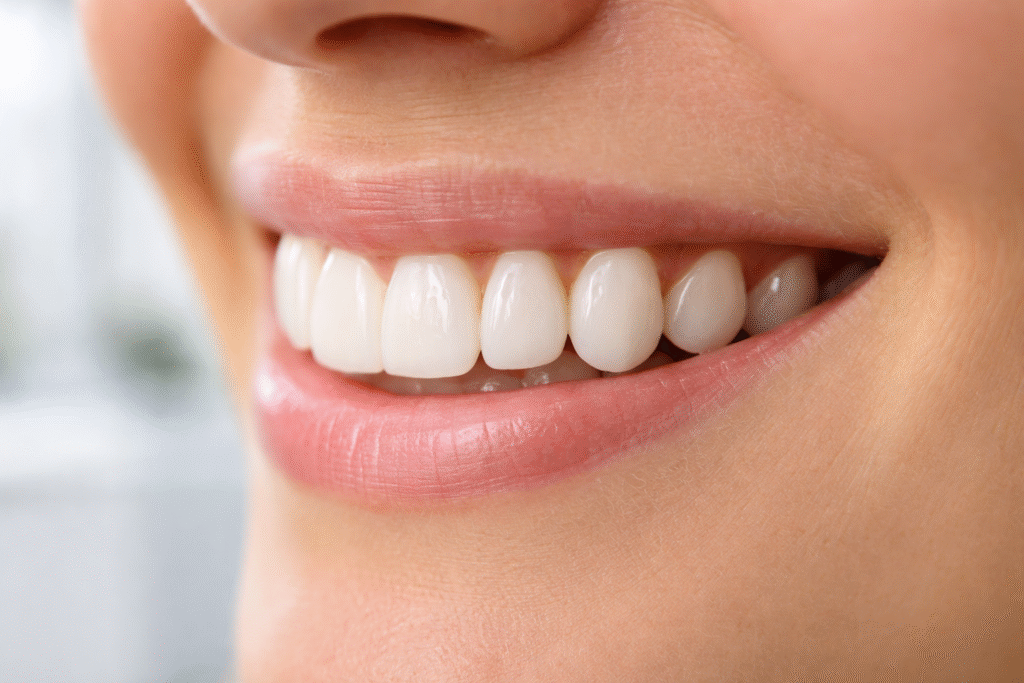
Pro tip: The contour of the gum around the implant plays a massive role in realism. Proper tissue shaping ensures the crown appears to emerge naturally from the gum line rather than looking artificial or overly symmetrical.
Why Patients Prefer a Natural Looking Tooth Implant
A natural looking tooth implant offers several advantages over other tooth replacement options:
- Permanent and fixed in place
- Preserves jawbone density
- Protects adjacent healthy teeth
- Restores full bite strength
- Exceptional aesthetic outcome
Unlike bridges, implants do not require shaving down neighbouring teeth, making them a more conservative long-term solution.
If you’re replacing a single missing tooth, you can explore our detailed guide on a dental implant for one tooth to understand how individual cases are carefully planned.
Clinical Evidence Supporting Natural Looking Tooth Implants
According to the Australian Dental Association, dental implants have success rates exceeding 95% when performed under appropriate clinical conditions.
At Bay Central Dental, our internal clinical audit over five years shows:
- 96–98% implant integration success rate
- Strong patient satisfaction in visible front-tooth replacements
- Improved chewing efficiency compared to pre-treatment status
Modern implant dentistry combines digital imaging, precision-guided placement, and high-grade ceramic materials to maximise both strength and appearance.
The Step-by-Step Process for a Natural Looking Tooth Implant
Restoring a missing tooth with a natural looking tooth implant involves a carefully structured sequence of clinical stages. Each step is designed to ensure optimal healing, structural stability, and a seamless aesthetic result. Rather than rushing the process, a staged approach allows both biological integration and cosmetic refinement to occur in a predictable and controlled manner, ultimately supporting the long-term success of your natural looking tooth implant.
Step 1: Comprehensive Consultation
The journey begins with a detailed consultation supported by advanced 3D imaging. During this appointment, bone volume, density, and gum health are thoroughly evaluated to determine whether the site can adequately support an implant. Digital scans also help identify important anatomical structures, ensuring precise planning and safe placement. This phase is not simply diagnostic, it forms the blueprint for a successful and natural-looking outcome.
Step 2: Implant Placement Surgery
Once planning is complete, the titanium implant is carefully positioned into the jawbone under local anaesthetic. The procedure is typically comfortable and performed with precision to optimise alignment and load distribution. Because the implant functions as an artificial root, accurate placement is critical for long-term stability and aesthetic positioning of the final crown.
Step 3: Healing & Osseointegration
Following surgery, the implant enters a healing period lasting approximately three to four months. During this time, osseointegration occurs, a biological process in which the bone fuses directly to the implant surface. This fusion creates a secure foundation capable of handling normal chewing forces. Allowing adequate healing time is essential to ensure the durability and strength of your natural looking tooth implant.
Step 4: Custom Crown Design
After successful integration, a custom ceramic crown is designed. Detailed impressions or digital scans are used to craft a crown that matches your surrounding teeth in shade, translucency, contour, and proportion. Careful attention is given to how the crown interacts with adjacent teeth and gum tissue, ensuring the final result blends naturally into your smile.
Step 5: Final Placement
At the final appointment, the crown is securely attached to the implant. Minor adjustments may be made to refine bite alignment and comfort. Once completed, the restoration looks, feels, and functions like a real tooth, completing your natural looking tooth implant and restoring both confidence and chewing efficiency.
Treatment Timeline Overview
Understanding the overall timeframe can help patients plan their treatment expectations realistically. While the surgical stage itself is relatively quick, the healing phase is what ensures long-term stability. The table below summarises the typical timeline.
| Stage | Estimated Duration | Purpose |
|---|---|---|
| Consultation | 1 visit | Planning & imaging |
| Implant Placement | 1–2 hours | Surgical placement |
| Healing Phase | 3–4 months | Bone integration |
| Crown Fitting | 1 visit | Final restoration |
As outlined above, the consultation and crown fitting typically require single visits, while implant placement is completed in one surgical appointment lasting one to two hours. The longest phase is healing, where bone integration occurs over several months. Although this period requires patience, it is precisely what allows the implant to become firmly anchored and function like a natural tooth for many years.
Pro tip: If the missing tooth is at the front, temporary aesthetic options can be arranged to maintain your smile appearance during the healing phase.
Who Is Suitable for a Natural Looking Tooth Implant?
You may be suitable if you:
- Have one missing tooth
- Maintain healthy gums
- Have adequate bone support
- Are in good general health
Patients who have lost a single tooth often make excellent candidates, particularly when the surrounding teeth remain healthy and intact. Replacing one missing tooth with a natural looking tooth implant allows the gap to be restored without compromising neighbouring teeth. Healthy gums are essential because they provide the soft tissue support that frames the implant and contributes significantly to its realistic appearance.
Adequate bone support is another critical factor, as the implant must integrate securely with the jawbone to achieve long-term stability. General health also influences healing capacity, especially during the osseointegration phase. In cases of bone deficiency, grafting procedures may be recommended to build a stable foundation before implant placement. Modern bone grafting techniques can significantly improve eligibility and long-term outcomes.
For more details about tailored treatment solutions, visit our single tooth implants service page to see how we personalise every case.
Comparing a Natural Looking Tooth Implant to Other Options
Before choosing a replacement option, it helps to understand how implants compare with bridges and dentures in terms of durability, function, and impact on oral health. Each solution has its place, but their long-term implications differ significantly.
| Feature | Natural Looking Tooth Implant | Bridge | Denture |
|---|---|---|---|
| Bone Preservation | Yes | No | No |
| Longevity | 15–25 years | 7–10 years | 5–8 years |
| Stability | Fixed | Fixed | Removable |
| Aesthetic Potential | Very High | High | Moderate |
| Impact on Other Teeth | None | Adjacent teeth altered | None |
As illustrated above, one of the key advantages of an implant is bone preservation. Because the implant functions as an artificial root, it stimulates the jawbone and helps prevent shrinkage. Bridges and dentures do not provide this stimulation, which may lead to gradual bone loss over time.
Longevity is another major distinction. While bridges and dentures may require replacement within a decade, a natural looking tooth implant can often last 15–25 years or longer with proper care. Stability and aesthetics also tend to favour implants, as they are fixed in place and carefully crafted to replicate natural enamel characteristics. Overall, a natural looking tooth implant remains the closest substitute to a real tooth in both function and aesthetics.
Long-Term Maintenance for a Natural Looking Tooth Implant
To maintain longevity:
- Brush twice daily
- Use floss designed for implants
- Attend routine dental reviews
- Avoid excessive grinding
Long-term success depends on consistent care and professional monitoring. Although implants do not decay like natural teeth, the surrounding gum tissue must remain healthy to prevent peri-implant disease. Using floss or interdental cleaning tools specifically designed for implants helps remove plaque around the implant crown. Regular dental reviews allow early detection of any issues and ensure the restoration continues to function optimally. With proper care, a natural looking tooth implant can last decades.
Ready to Experience the Benefits of a Natural Looking Tooth Implant?
A natural looking tooth implant is one of the most advanced and reliable ways to replace a missing tooth while preserving jawbone health and restoring confidence.
At Bay Central Dental, we combine digital precision, implant expertise, and cosmetic craftsmanship to deliver results that look completely natural and feel secure.
Your Next Steps:
- Book a personalised consultation
- Undergo 3D imaging assessment
- Review your customised treatment plan
- Begin your implant journey with confidence
Visit our website today to schedule your appointment and take the first step towards restoring your natural smile.
FAQs (Frequently Asked Questions)
Will a natural looking tooth implant match my smile?
Yes, a natural looking tooth implant is carefully designed to blend harmoniously with your existing teeth. Dentists use precise shade-matching systems and advanced ceramic layering techniques to replicate the translucency, texture, and light reflection of natural enamel. The shape and contour of the crown are also customised to complement your facial features and bite alignment, ensuring the final result integrates seamlessly into your smile rather than standing out.
How long does a natural looking tooth implant last?
The titanium implant post, which is placed into the jawbone, can last decades when properly maintained with good oral hygiene and regular dental visits. The visible ceramic crown attached to the implant is also highly durable, but like any dental restoration, it may eventually require replacement after many years due to normal wear and tear. Factors such as grinding habits, oral hygiene, and general health can influence longevity.
Is the procedure painful?
The implant procedure is typically performed under local anaesthetic, so patients do not feel pain during the surgery itself. After the anaesthetic wears off, mild swelling or tenderness is common and is often compared to the discomfort of a simple tooth extraction. This temporary soreness is usually manageable with prescribed or over-the-counter pain relief and subsides within a few days.
Can people tell I have an implant?
When properly planned and crafted, it is extremely difficult for others to distinguish a dental implant from a natural tooth. Modern materials and digital imaging allow dentists to replicate subtle details such as enamel translucency and natural tooth contours. As a result, the implant crown blends so naturally with surrounding teeth that most people will not notice any difference.
How long does the process take?
The full process generally takes between 3–6 months, depending on individual healing and whether additional procedures are required. After the implant is placed, a healing period is necessary to allow the implant to integrate securely with the jawbone. Once integration is complete, the custom-made crown is attached, completing the restoration.
Is it worth the cost?
Many patients consider a natural looking tooth implant a worthwhile long-term investment because it offers durability, aesthetic excellence, and functional benefits. In addition to restoring appearance and chewing ability, implants help preserve jawbone structure by stimulating the bone similarly to a natural tooth root. While the upfront cost may be higher than some alternatives, the long-term stability and natural appearance often make it a valuable solution.